Project
AI Telegram Automation
Promotional emails turned into approved Telegram posts, and a customer bot with an AI consultant, delivery calculator and order capture.
Overview
Four connected n8n workflows for a Telegram-based business that buys goods in the EU and delivers them to CIS countries. They solve two problems: turning promotional emails into channel posts without manual copywriting, and answering customers around the clock.
Email to channel post, with human approval
- Gmail is polled every minute for emails under one label, so only the offers the owner selected are processed.
- Each message ID is looked up in Supabase before any work starts: no duplicate posts and no wasted LLM calls.
- The email is stripped of HTML, scripts and tracking links and trimmed to fit the model’s context; the largest attached image becomes the banner and is stored in Seafile.
- An LLM extracts the brand, offer, dates, promo code and conditions and writes a short Russian post. If the primary model fails, a fallback model takes over.
- A custom escape step keeps the bold markup valid for Telegram MarkdownV2, avoiding the “can’t parse entities” errors that often break bots.
- The draft is saved and sent to the owner with Publish and Regenerate buttons; a separate error workflow reports any failure.
A second workflow handles the buttons. Publish sends the post to the channel, as a photo with caption when there is a banner. Regenerate asks the model to rewrite the draft with the same facts and updates the approval message in place; Decline closes it. The action and the draft ID travel in the button data, so the handler is stateless. Nothing reaches the channel without the owner’s tap.
Customer bot: AI consultant and delivery calculator
- An AI agent answers from the service’s own rules (ordering, delivery times, payment, prohibited items, commission, insurance, returns, customs limits) through RAG over Supabase pgvector, instead of guessing.
- A live exchange-rate tool converts prices such as “89 EUR” or “1,500 CZK” to rubles with the correct cross rate; every quote says it is preliminary.
- Per-chat memory keeps the conversation natural, and validated structured output (question, calculation, order or fallback) routes each reply.
- A button-driven calculator walks through carrier and parcel weight and reads the price and delivery time from a tariff table; its state lives in the button data, so no session storage is needed.
- Orders from chat or from the calculator are written to the database, the owner is notified in Telegram and the customer gets a confirmation.
The complete Supabase schema was delivered as SQL: the vector table with its index and search function, a tariff table seeded with 16 bands across four carriers, and orders. A small loader workflow lets the client edit questions and answers and re-embed the knowledge base without touching code.
Results
- Email-to-channel publishing reduced to a single approval tap.
- Repetitive customer questions answered around the clock from a controlled knowledge base.
- Delivery quotes in seconds instead of manual replies; every order captured and pushed to the owner in real time.
Workflows
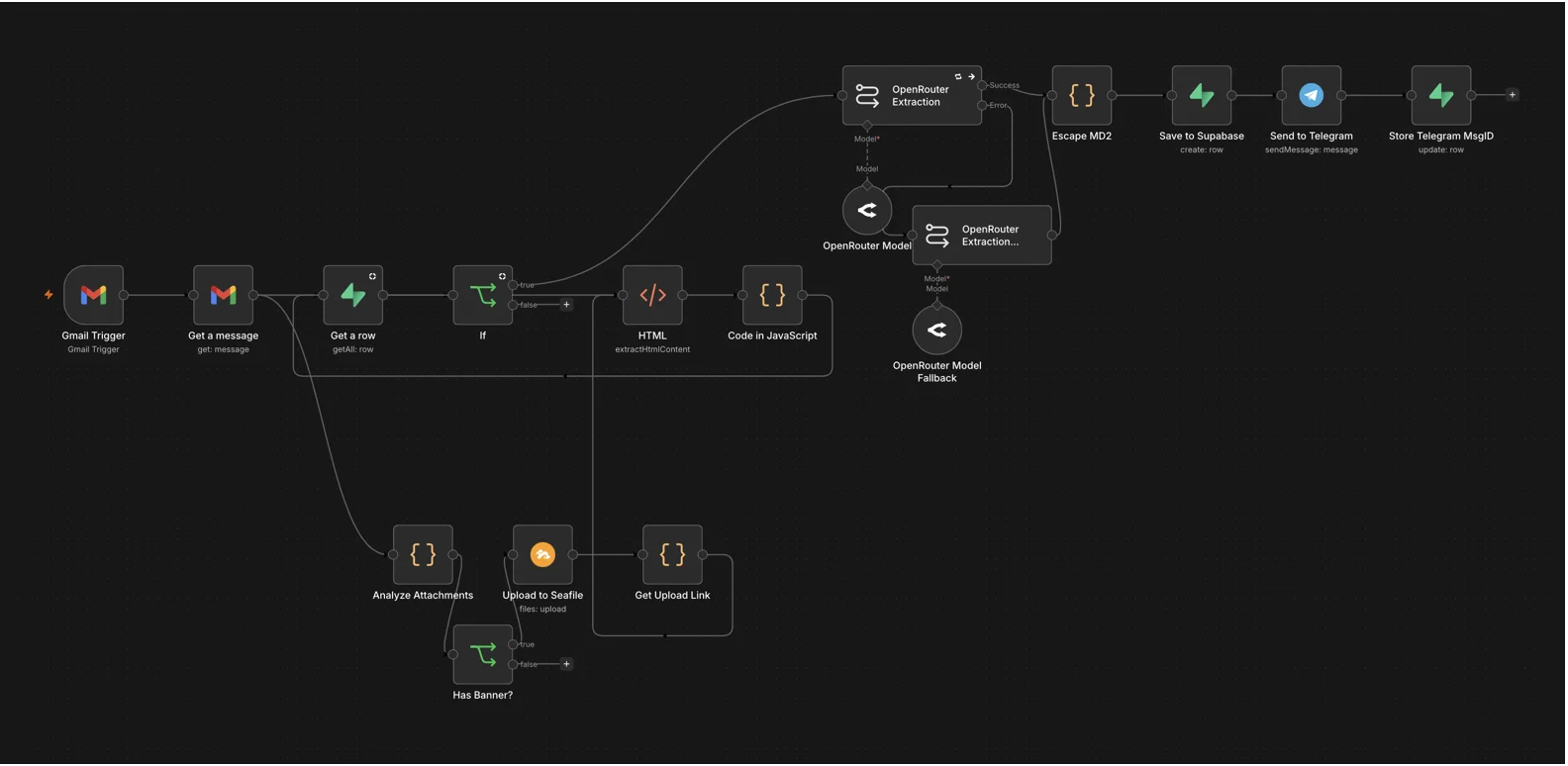
Email to draft: Gmail, deduplication, banner, LLM with fallback, approval message
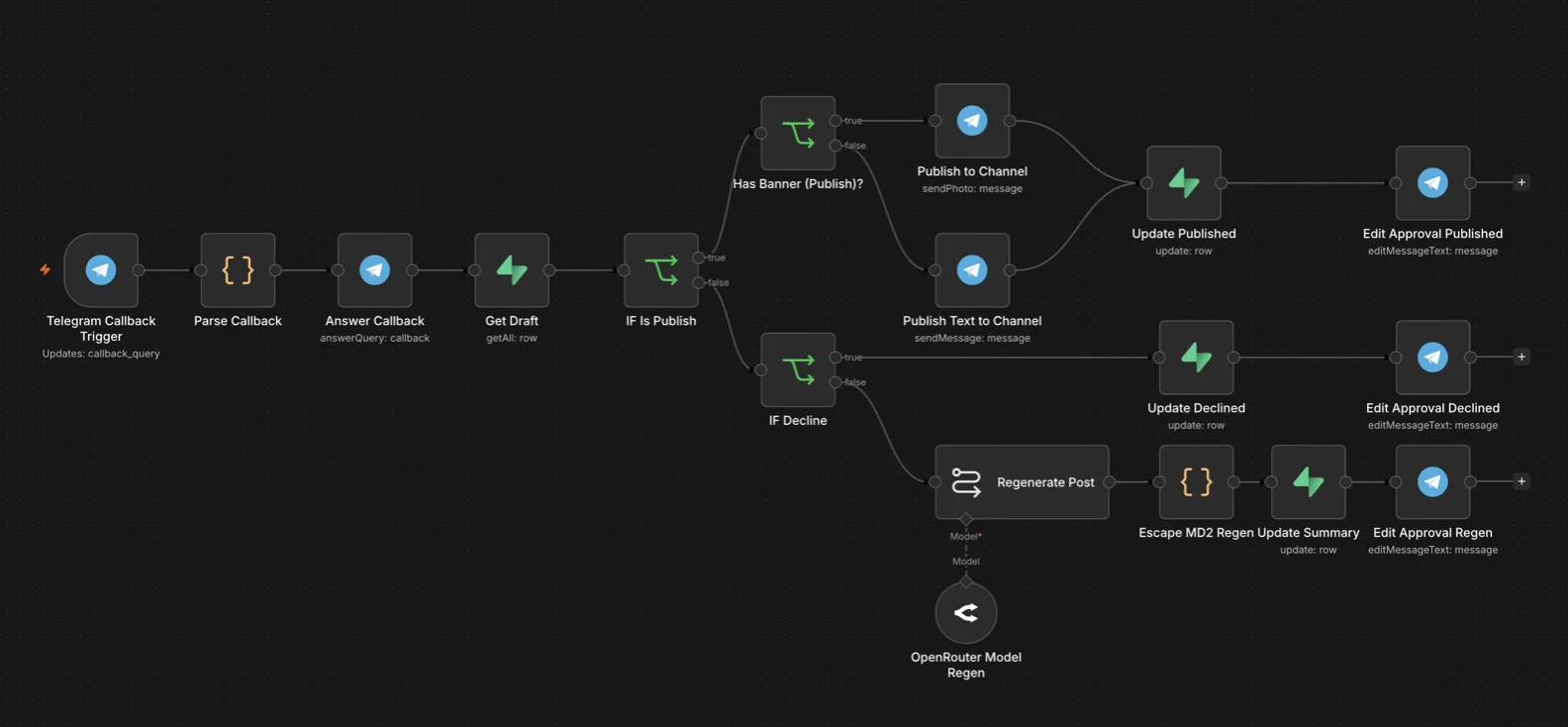
Approval handler: publish, decline or regenerate
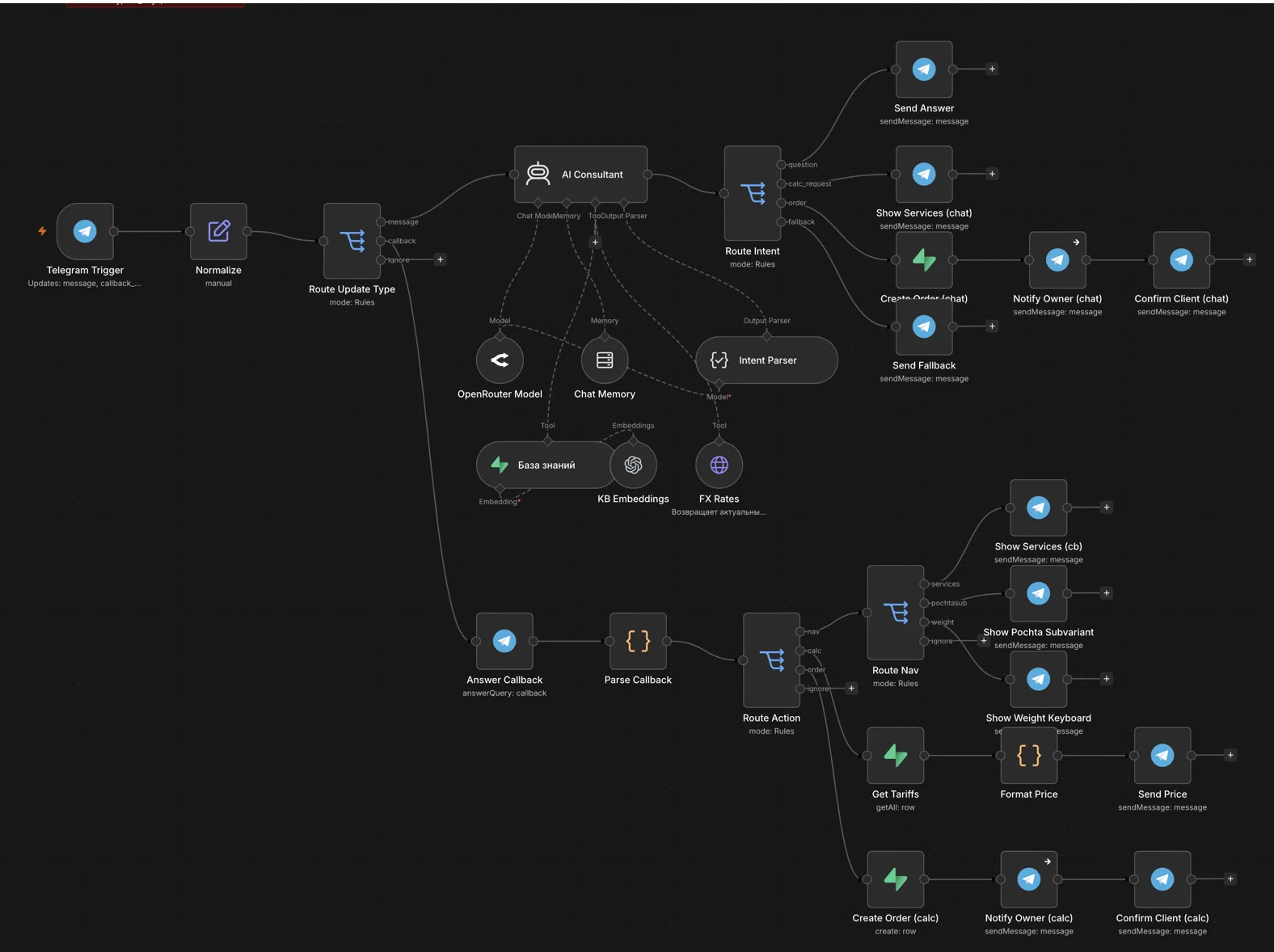
Customer bot: AI consultant and button-driven delivery calculator
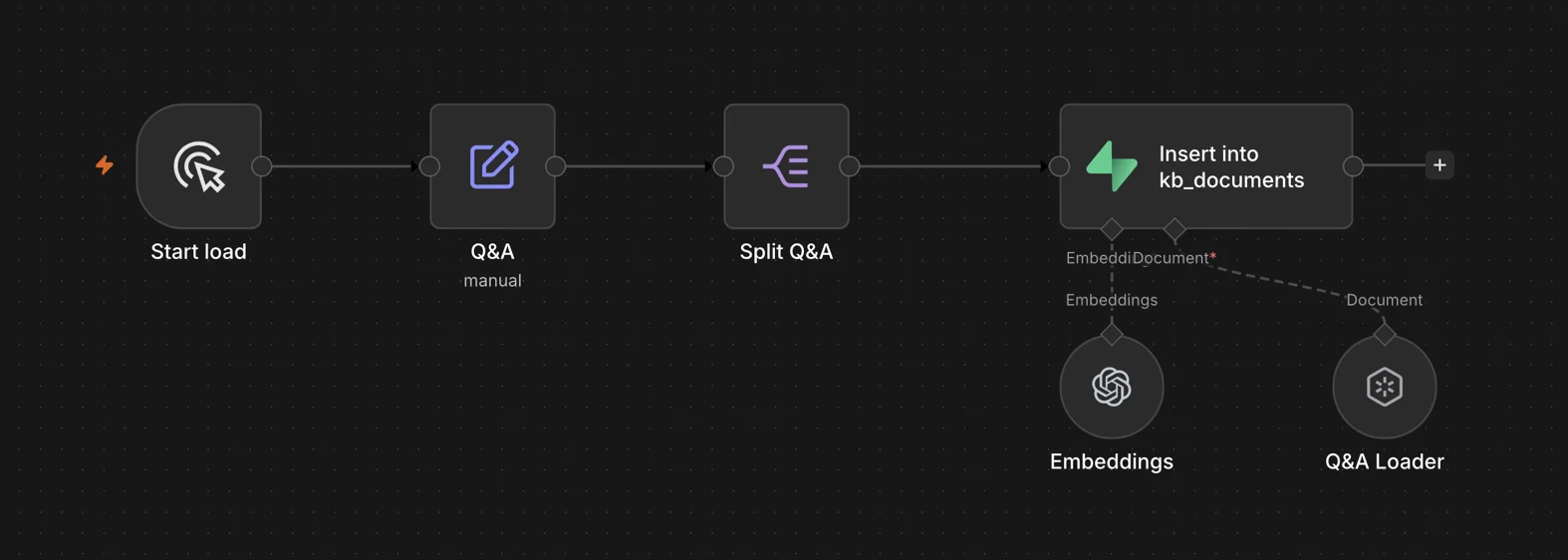
Knowledge-base loader
Facts
- Type
- Client project · n8n automation
- Role
- Automation engineer: all workflows, the AI agent and the database
- Scope
- 4 connected workflows and the database schema
- Stack
- n8n, Telegram Bot API, OpenRouter (Claude, Gemma), OpenAI Embeddings, Supabase (Postgres, pgvector), Gmail API, Seafile, JavaScript
Links